Validation Summary
Sentinel-5p TROPOMI provides one operational ozone profile data product: L2_O3_PR Ozone Profile
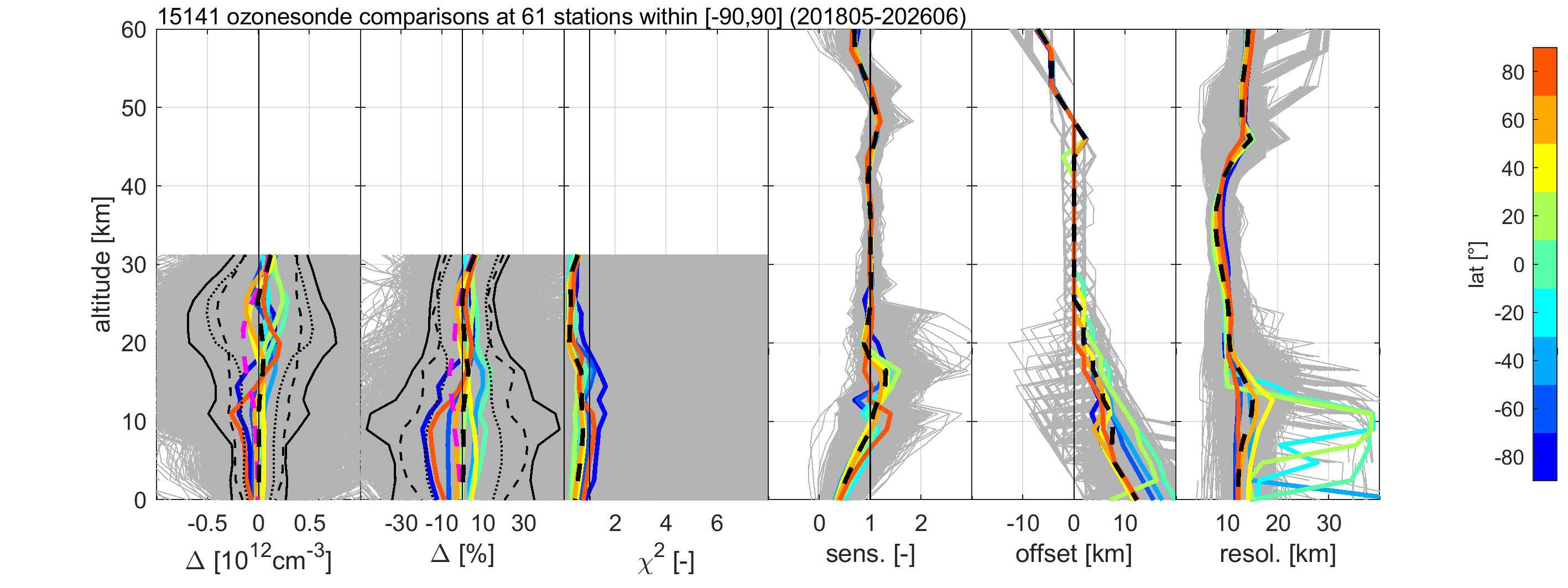
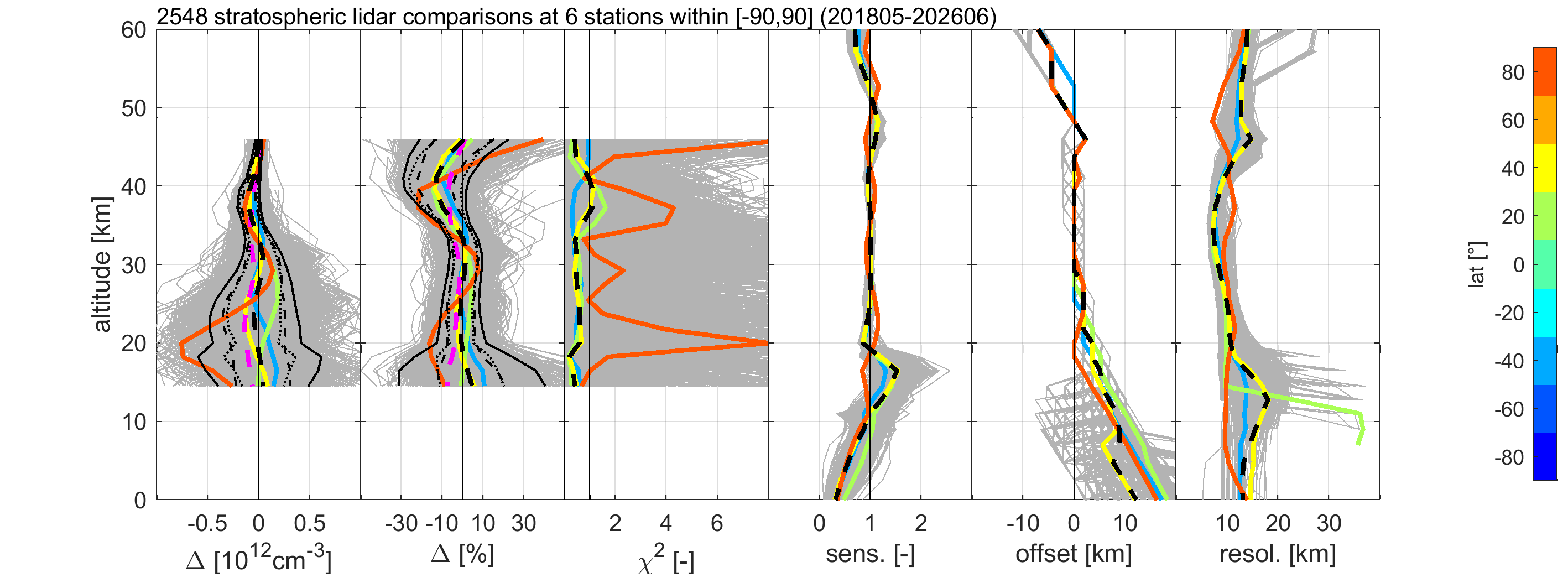
Comparison of the Sentinel-5p TROPOMI L2_O3_PR data (May 2018 to June 2026 for both NRTI and RPRO/OFFL channels of the operational NL-L2 processors) with ozonesonde and lidar measurements concludes to a median agreement better than 5 to 15 % in the troposphere and up to the upper troposphere/lower stratosphere (UTLS). The bias goes up to -15 % in the higher stratosphere (35-45 km) as well, but with vertical oscillations. The comparisons show a dispersion of order of 30 % in the troposphere, and 10 to 20 % in the UTLS and upper stratosphere. Chi-square tests demonstrate that on average the observed differences confirm the ex-ante satellite and ground uncertainty estimates in the stratosphere, above about 20 km. Around the tropopause and below (around 15-20 km and lower), the mean chi-square value increases up to about four, while median values stay close to unity. Validation results for the current v02.09 are similar to those for v02.08, but do not show the strong cloud fraction dependence of the latter. Instead, a stronger dependence of the retrieved tropospheric ozone amount on the surface albedo is observed.
The information content of the ozone profile retrieval is characterised by about five to six vertical sub-columns of independent information (estimated from the Degrees of Freedom) and a vertical sensitivity nearly equal to unity at altitudes from about 20 km (UTLS) to 50 km and decreasing rapidly at altitudes above and below. The altitude registration of the retrieved profile information usually is close to the nominal retrieval altitude in the 20-50 km altitude range and shows positive and negative offsets of up to 10 km below and above the 20-50 km altitude range, respectively. The effective vertical resolution of the profile retrieval usually ranges within 10-15 km, with a minimum close to 7 km in the middle stratosphere. Increased sensitivities and higher effective vertical resolutions can be observed for higher solar zenith angles, as can be expected, and correlates with higher retrieved ozone concentrations. On the other hand, one can also observe some lower-DFS profiles with nearly-zero surface sensitivity in combination with a highly overcompensating sensitivity around the UTLS, ranging up to three and above. These retrievals occur for scenes that have both high SZA and high surface albedo, mostly around the Antarctic (latitudes from 60 to 90 south). An optical path length dependence, including solar-zenith angle and viewing-zenith angle dependence, is observed for the lowest ozone sub-columns, which translates into a seasonal and meridian dependence of the bias.
The more than eight years of TROPOMI ozone profile data show a slight DFS degradation throughout the mission (next to a jump from the ground pixel resolution change). Comparisons with ozonesonde data reveal significant positive drifts near 2 %/year in the tropics and mid-latitudes from the surface to the UTLS, while closer to 1 % per year negative drifts are observed above. This makes the current operational TROPOMI ozone profile product and its subcolumn derivatives unsuitable for vertically resolved trend studies. However, no significant drift is detected for the vertically integrated profile. This agrees with the operational TROPOMI total ozone column retrieval, although the latter is consistently about 5 % higher than the integrated ozone profile.
| Product ID | Stream | Version | Orbits | Bias (req. 30 %) | Disp. (req. 10 %) | Special features |
|---|---|---|---|---|---|---|
| L2_O3_PR | NRTI |
02.04.00 |
24697-28074 |
5-15 % | 10-30 % | Mean agreement better than 15 % in the troposphere and UTLS. Bias goes up to -15 % in the higher stratosphere (35-45 km) as well, but with vertical oscillations. Dispersion of order of 30 % in the troposphere, and 10 to 20 % in the UTLS and upper stratosphere. Despite positive (troposphere) and negative (stratosphere) drifts at individual levels, no significant drift is detected for the vertically integrated profile. |
| OFFL | 02.04.00 02.05.00 02.06.00 02.07.01 02.08.00 02.09.01 |
24655-28030 28031-31704 31705-35777 35778-36756 36757-42022 42023-now |
5-15 % | 10-30 % | ||
| RPRO | 02.04.00 | 2818-24779 | 5-10 % | 10-30 % |
The graphs below show the comparison between S5P L2_O3_PR OFFL ozone number density profile data and all co-located ground-based reference measurements (May 2018 to June 2026, top: ozonesondes, bottom: stratospheric lidar). From left to right: the difference and the percent relative difference between S5P and ozonesonde data, the chi-square profile, the vertical sensitivity, the altitude registration offset, and the averaging kernel FWHM associated with the S5P retrieval. The colour scale indicates the latitude band. Black dashed lines show mean values (thick lines) and standard deviations (thin lines, around the mean), while magenta dashed lines indicate the mean difference between the a-priori profile and the reference measurement. Dotted black lines indicate the total ex-ante (inductive) uncertainty of TROPOMI and the reference measurements combined (around the mean difference).
A detailed description of the method and a comprehensive discussion of validation results can be found in the Quarterly Validation Report #31: April 2018 - May 2026.