Validation Summary
The validation of the wavelength assignment of the S5P L1B_UVN v02.00.00 products concludes to an agreement to within 0.01 nm, which is within the pre-launch calibration uncertainty.
Radiance
The radiance in bands 1-3 is up to 5 % smaller than OMPS-nadir radiance; above 320 nm, this is a wavelength independent bias. Below 320 nm, the wavelength dependence seems to vary with the latitude. In band 1 around 280 nm, the radiance deviates more than 10 % from OMPS values. The absolute radiometric calibration for UV radiance lacks accuracy and as a result may be updated in the future. In the spectrally overlapping regions of bands 2 and 3 there is a discrepancy of about 2 % in the L1b radiance signals. The radiance in band 6 was compared to modelled spectra in the continuum around the O2-A band. The signal of TROPOMI is 1-2 % lower than the modelled radiance. For bands 1 to 6 (UV, UVIS and NIR) degradation has been observed for the radiance. The degradation is the largest at short wavelengths. The decrease in radiance signal per 1000 orbits is between 0.31 % in band 1 and 0.02 % in band 6. The correction of the radiance degradation is active in the forward stream from version 02.01.00 on (orbit 24688, 19.07.2022). The absolute and relative radiance radiometry of the SWIR bands were validated using reference stations in Railroad Valley and in the Saharan desert. Current validation results give upper limits of < 5 % for the absolute calibration and < 0.8 % for the relative calibration.
Irradiance
The absolute irradiance calibration of TROPOMI has been compared to other published solar reference datasets. After an update to the calibration based on OMPS-nadir data, the UV and UVIS spectrometers agree within 0-5 % with the references. For extreme swath angles, the deviations are larger in the UV. For the NIR spectrometer the irradiance spectrum is approximately 1.5-3.5 % lower than the reference spectra. The SWIR spectrum is approximately 0.6 % lower than the closest reference spectrum.
The irradiance for L1B version 02.01.00 and version 03.00.00 in TROPOMI bands 2 and 3 agrees well with corresponding OMPS-NM measurements from June 2018 to September 2026. No wavelength dependence is observed. The ratios and their spectral structures are very stable over the entire period.
Reflectance
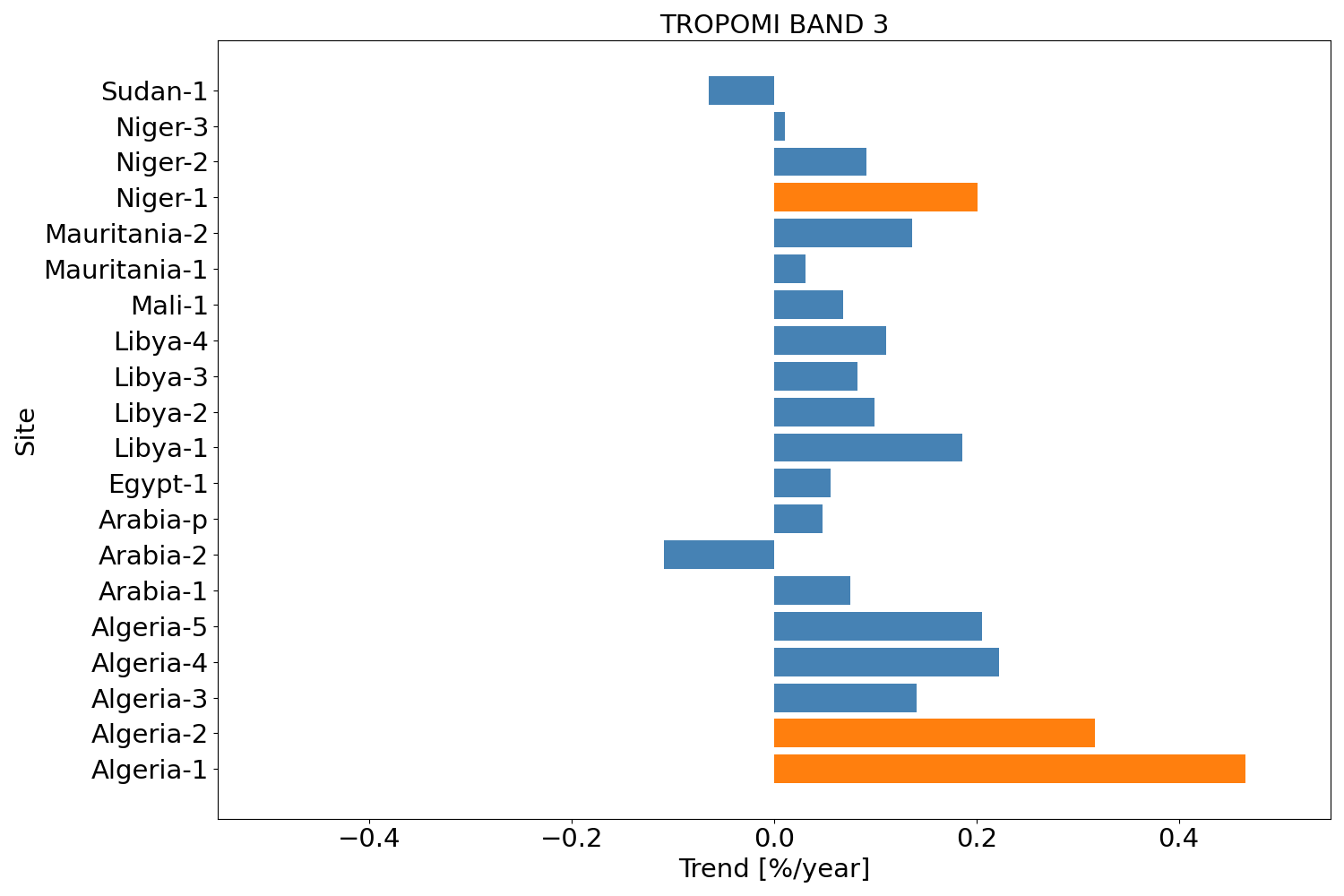
The stability of the reflectance derived from TROPOMI L1B versions 02.01.00 (until 22 November 2025) and 03.00.00 (from 22 November 2025 onward) in bands 3, 4, and 6 has been obtained from cloud-free nadir measurements over 20 Pseudo-Invariant Calibration Sites in the Saharan Desert and Arabian Peninsula from May 2018 through August 2026. For all bands, the long-term drift is statistically not significant for the bulk of 20 sites.